- Culture & Travel
Ladakh’s Pink Blossoms Are An Exquisite, Luxurious Celebration
- ByRadhika Bhalla

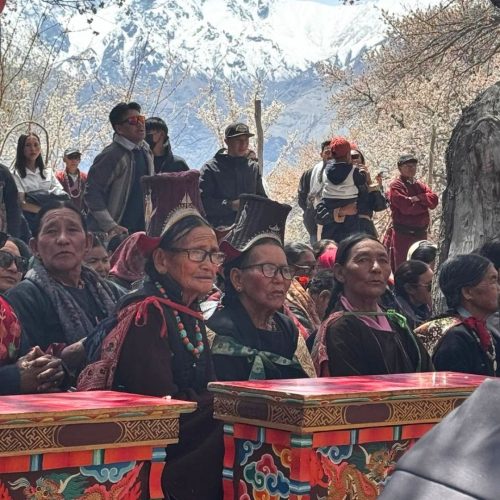
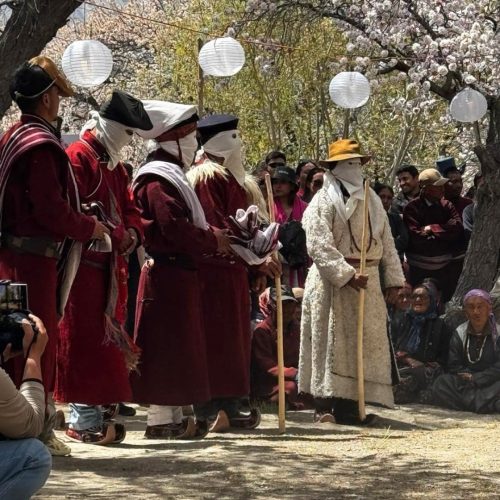
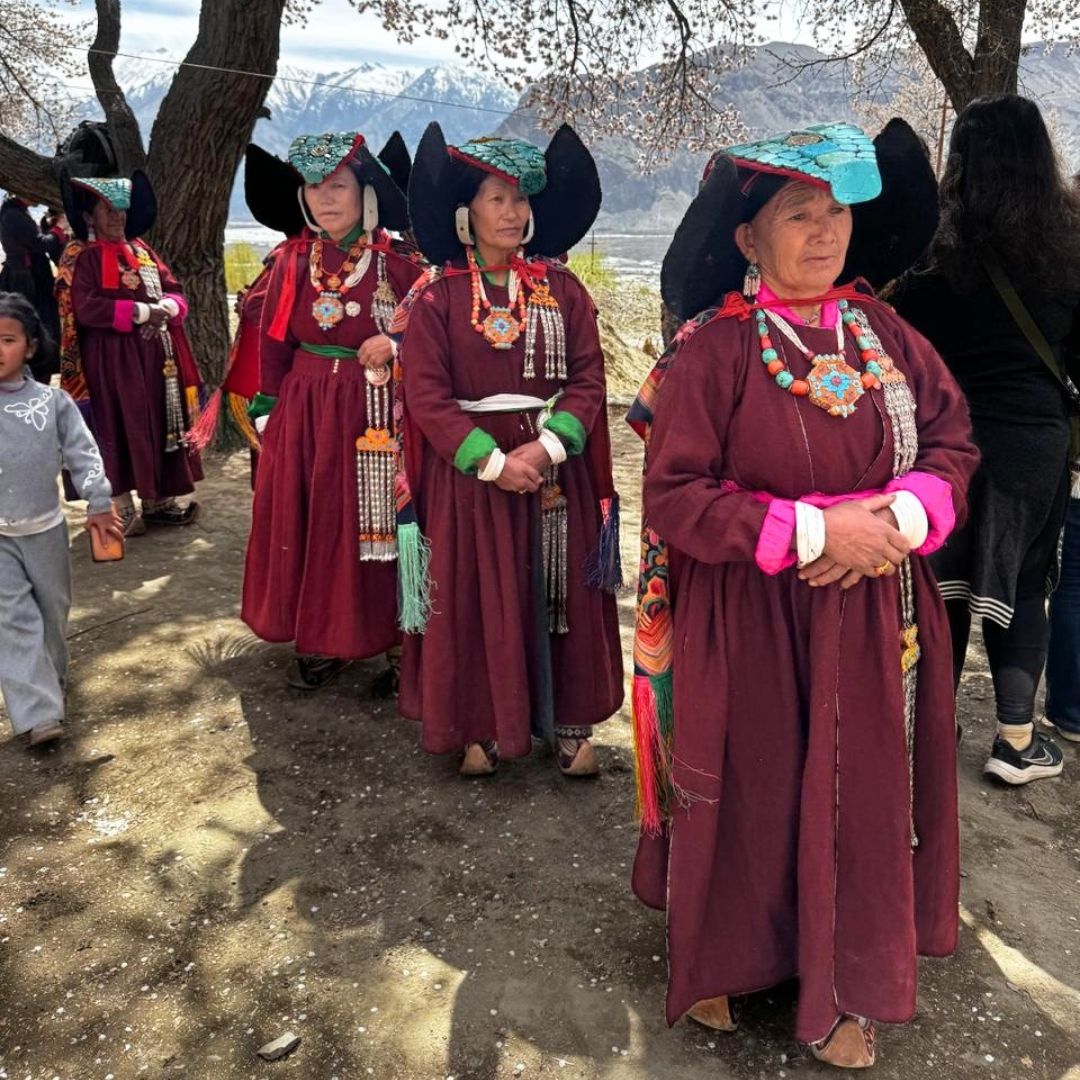
Women weaaring peraks and traditional robes during the Apricot Blossom Festival in Ladakh. (Photo/Radhika Bhalla)
An ancient caravan meanders along the Silk Route, laden with spices and salt, fabrics and precious stones. At every turn, its travellers are greeted by majestic mountains, and treacherous passes, with a turquoise river guiding the way. The intrepid travellers continue, days turn to weeks, they finally reach their refuge in a valley where the mountains meet and the land turns to pink as Spring arrives.
This is the ‘valley of flowers’, the Nubra Valley of Ladakh that’s witnessed nomads, pilgrims, and warriors for millennia. A vital trading hub since the 2nd century BC, it remains one of the most fascinating corners of the Himalayas. A famous cold desert of the region, this is also where The Word. Magazine was invited by Rare India in April to witness the once-in-a-lifetime Apricot Blossom Festival.
And a once-in-a-lifetime experience, it was.
Our journey began in Leh, and over the course of a week, we made our way to the furthest reaches of Ladakh. With the landscape changing every few hours, the old adage bore truth…the journey here is every bit as rewarding as the destination.
IN THE LAND OF THE LAMAS
Our flight took off from the sweltering heat of New Delhi, and I booked a seat on the left of the plane, having read that the views of the mountain peaks were better from there. Nothing, of course, could prepare me for the breathtaking, ice-capped peaks. And this was just a prelude.
We landed in the Kushok Bakula Rimpochee Airport, one of the highest airports in the world, which is also a military airfield of the Indian Air Force. It’s flanked by mountains on all slides, and absolutely no photography is allowed here. A newer, swankier airport is under construction, and I was lucky to make my way through the delightfully quaint one, where I became acutely aware of two things…
One, it was pretty cold for April.
Two, it felt like time was already beginning to slow down.
where we spent two delightful days acclimitising to the environment.
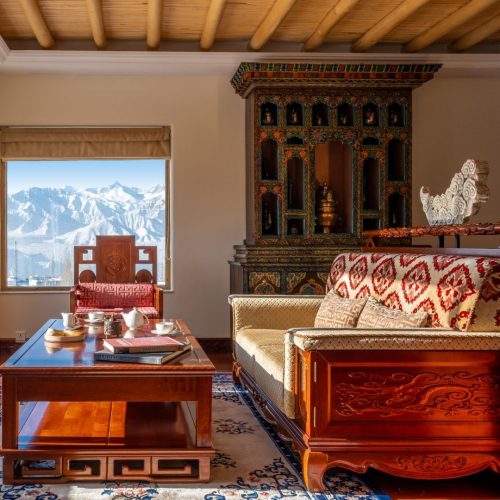
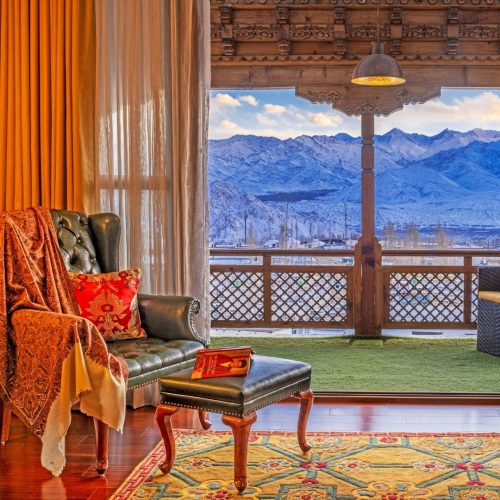
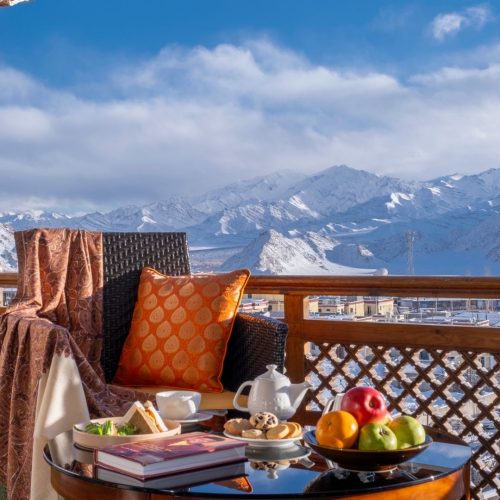
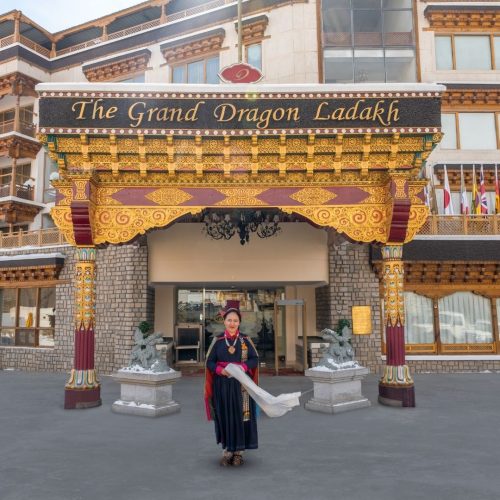
Under the crisp sunshine, we made our way to the first destination. The Grand Dragon Ladakh which is barely 10 minutes away from the airport. This family-run resort was Leh’s first-ever 5 star luxury hotel, with humble beginnings in 1974 as a two-room guesthouse, when Ladakh was first opened for tourism. In 2007, the next generation of the Abdu family upgraded it to 76 sprawling rooms and suites, complete with oxygen humidifiers and panoramic views of the Stok Kangri, one of the world’s highest trekking peaks.
This is a favourite spot for guests to unwind and acclimatise, for Leh sits on a high altitude of 11,500 feet with lower oxygen levels, and all travellers need mandatory rest for 24 to 48 hours upon arrival. The Grand Dragon Ladakh is a delightful combination of traditional crafts and modern amenities, offering guests a first taste of the cultural flavours to come. The interiors of are an ode to local, sustainable architecture, such as the Rabsal carved wooden balconies, and everything from the carpets to framed jewellery in each room celebrate handicraft.
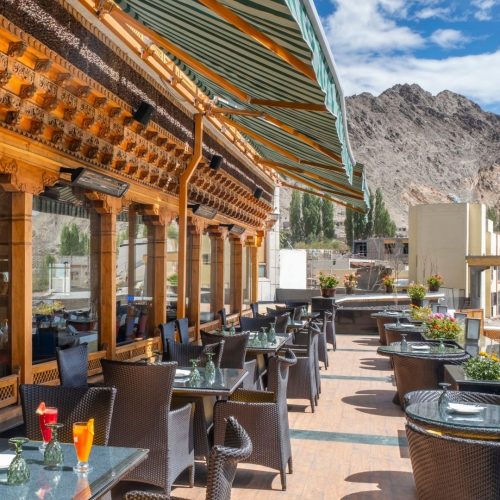
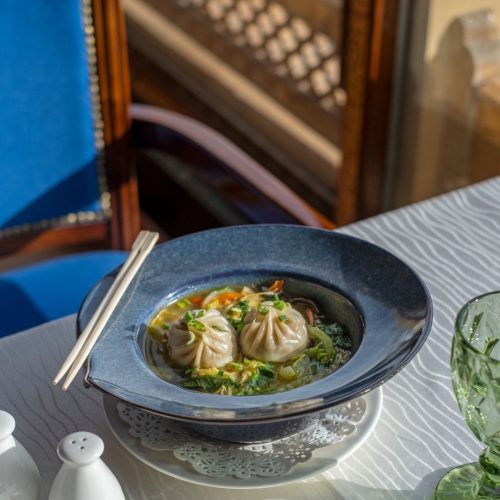
On the first two days, your body will naturally want to rest. But for those in the mood to partake in a non-exerting activity, you can request the hotel to book you a calligraphy class in the local Bhoti script, for which a monk from a far-off monastery will come to specially teach you. It’s essential you eat light while acclimatising, too, and The Grand Dragon Hotel’s restaurant is perfect for two reason: One, the thukpa, here, is legendary (put it up on your social media to witness the proof of its fame). Two, the space is nothing short of living art—as we were informed by the third generation running the hotel, Danish Din, the jewel-toned paintings were made by monks in the traditional Ladakhi style, resplendent with rich detailing and gold carvings.
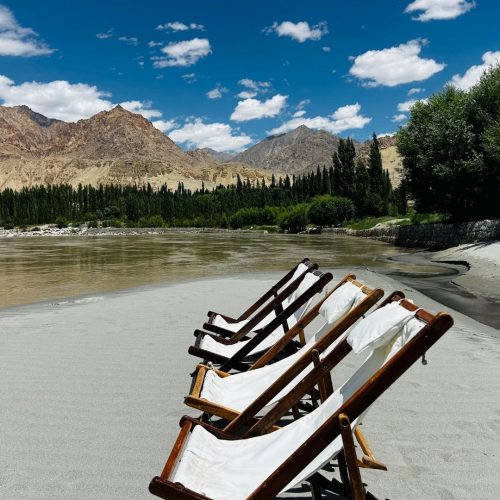
On day 2, you can step out a bit, and the hotel can arrange a picnic for you by the Indus River under apricot blossoms, if you ask in time. By night, you’ll be invited for a bonfire under the stars, with freshly-cooked meals and a blanket of stars for company. Soak it all in, for this will set the tone for the days to come…
OF FAITH AND FORTUNE
Travel is a gift for the soul. And a visit to one of the many monasteries of Leh is testament to it, each one is alive with faith, practices, and artworks of the Buddhists gods and goddesses. Nestled within the mountains, these white coloured monasteries appear plain from the outside, with rows of small windows. But step inside, and it’s a different world altogether.
The largest and wealthiest among them is the Hemis Monastery, located on the west bank of the Indus River. This monastery was founded in the 11th century and re-established in 1672, with its walls adorned with paintings of Bodhisattvas and gilded statues housed inside.
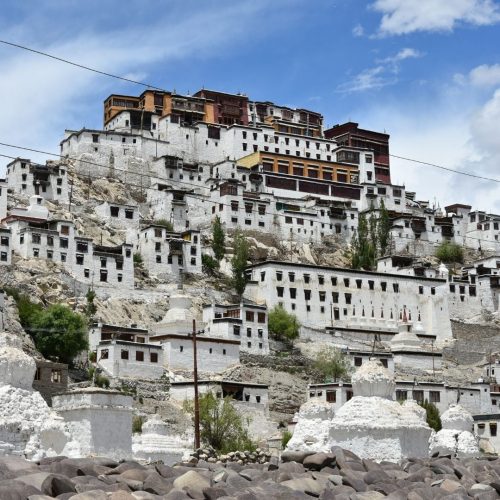
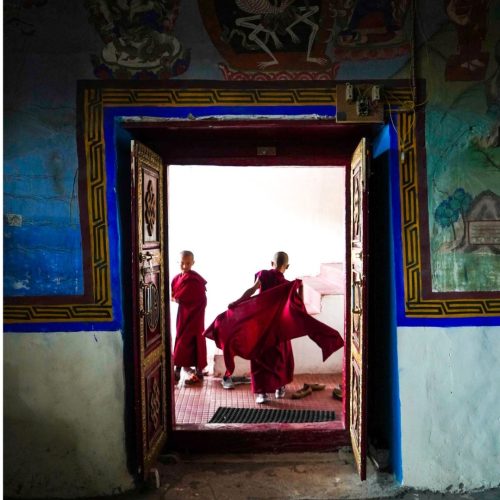
Another famous one is the Thiksey Monastery, an hour away from Leh, where I went before lunch. Situated atop a hill, the 12-storey complex resembles the famous Potala Palace in Lhasa, Tibet, and was built in the mid-15th century. As I walked up the white stone steps, I came across a resting spot with a large prayer wheel and a beautiful fresco running across the wall. A tiny monk clad in maroon robes ran out of a room, jumping down the steps, laughing away. It was almost like out of a dream.
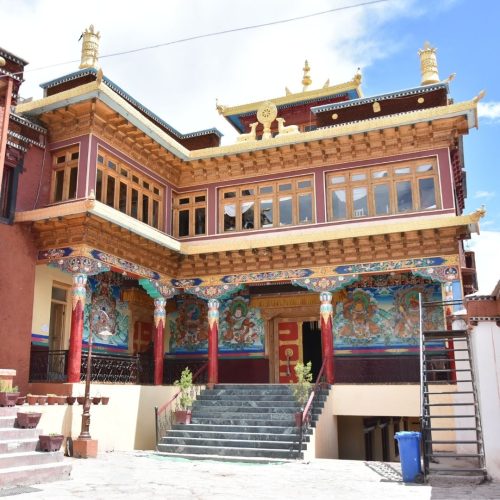
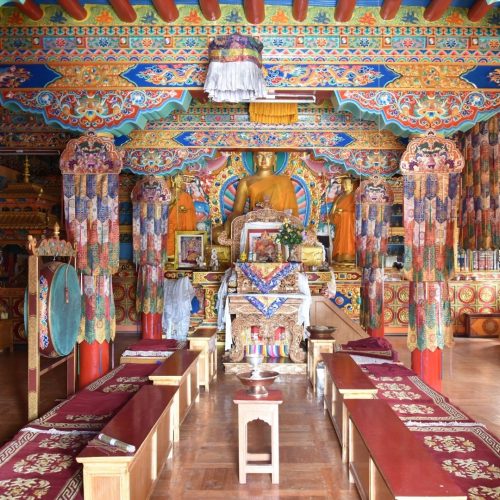
In the Thiksey Monastery, there is a central courtyard surrounded by 10 temples. I first climbed up the stairs to the wooden assembly hall that is covered in frescos of Bodhisattvas like Manjusri and Avalokateshwara, In the inner sanctum, there is a golden statue of Gautam Buddha along with rows of deities. A flight higher than this temple is another one dedicated to the Thiksey protector deity Vajrabhairava, a fierce looking, large figure with his acolytes. Just as I was about to leave this hallowed space, a young monk walked in, took his seat, and began chanting incantations, beating a rhythm on a drum and cymbals. I sat there for what felt like eternity, because time didn’t matter anymore…all that existed was a higher power.
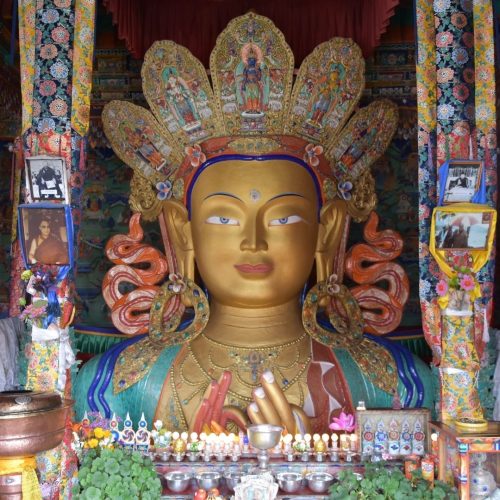
Before leaving the monastery, I made my way to the most famous temple in the precint, where a 49-feet-high statue of the Maitreya Buddha resides. This temple was erected in 1970 to commemorate a visit by the 14th Dalai Lama, and the statue covers two stories. A large, peaceful, golden face holds your gaze, with a shell-like third eye between the brows, and there are vibrant paintings of Bodhisattvas in every corner. Maitreya Bodhisattva is the Buddha of the future, and holds the promise of restoring peace and balance when all is lost. At a time like this, a prayer can hold much meaning…
THE LAST SHANGRI-LA
The next day, we set off for the “last village of India”, Turtuk in the Nubra Valley. An eight-hour journey from Leh, this village was among the furthest occupied by the Indian Army from Pakistan in 1971, now located around 10 kms from the Line of Control (LOC). Turtuk was, until 2010, banned for tourists to visit, and even today, you need a permit to visit it (which you can apply for online and receive within an hour).
Before leaving Leh, I made sure my phone was fully charged and had enough free space…a capital idea because the views are breathtaking along the way. On one journey, I got to see snow, desert sand, rivers, and blossoming trees, and I still couldn’t get enough.
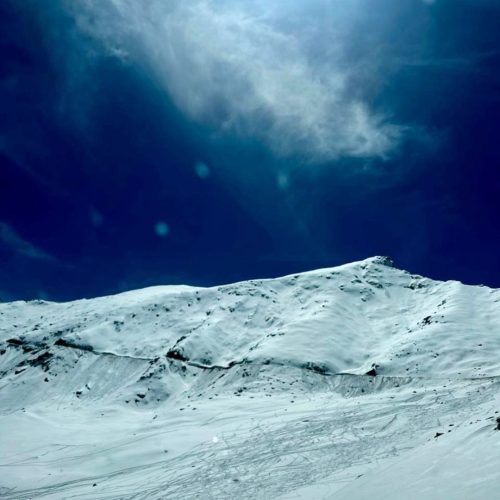
To reach Turtuk, one must pass through Khardung La, which is one of the world’s highest motorable passes at approximately 17,982 feet. Blanketed in snow till well into early summer, the drive through this landmark of the Ladakh mountain range is awe inspiring. One almost feels like you can touch the snow peaks as you drive through them, and it’s a blessing that the Internet doesn’t catch here in many parts. Along the way, you can’t help but wonder about the greatness of the mountains, and the ages is took for them to be formed. All one can do, really, is take it all in, best done in silence.
For the most part of the drive, the rugged Karakoram range forms the backdrop, framed by the Himalayan range and the Ladakh range. The turquoise Shyok River is a loyal companion along the drive—a river once deeply revered and feared for its unpredictable nature, earning it the sobriquet of the ‘River of Death’.
We stopped for a break at Diskit, where I was greeted by a pack of very hungry, very fluffy mountain dogs. A hot cup of tea and a plate of dumplings later, we were back on the road, and soon, the landscape changed to arid, desert sand, formed by the mighty Himalayan mountains. Amidst the canvas of rock and sand, the turquoise blue waters of the Shyok river punctuated the views.
As we drew closer to the northernmost Balti villages, As we drew closer to the northernmost Balti villages, the landscape softened. Poplar trees lined the roads, cultivated fields appeared, and almost out of nowhere, a blush of pink emerged on the horizon—the first apricot blossoms of the season, soon to blanket the rugged valley in delicate hues. We had arrived in Turtuk.
Brangsa, meaning “a place of rest” in the local dialect.
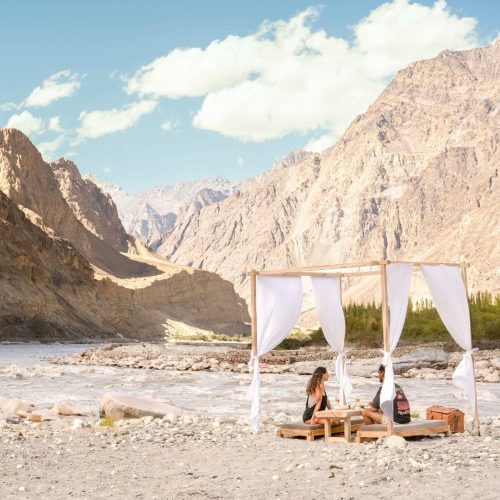
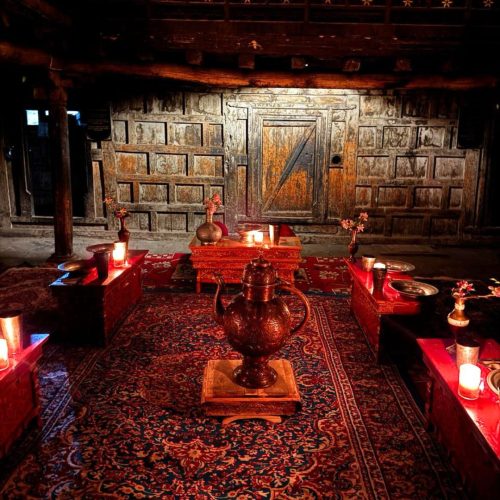
My favourite experience was dining with the royal Yabgo family at their ancestral palace through Virsa Baltistan’s exclusive ‘Dine With Dynasty’ experience. The approach to the palace follows a stone-hewn pathway, leading to an entrance marked by a large eagle sculpture perched above the doorway. Built by Raja Turab Khan in the 15th century, the residence belongs to the Yabgo dynasty, whose lineage stretches back nearly 2,000 years.
The current king, Mohammad Khan Kacho, is a warm and engaging host. Over dinner, he shared stories of his passion for polo and horse riding, memories of the India-Pakistan conflict, and accounts of how the family home endured occupation during times of war. Seated in the courtyard beneath candlelight, we were served traditional Balti dishes, many of which are eaten cold rather than piping hot—a fascinating cultural difference.
exclusive ‘Dine With Dynasty’ experience. (Photo/Radhika Bhalla)
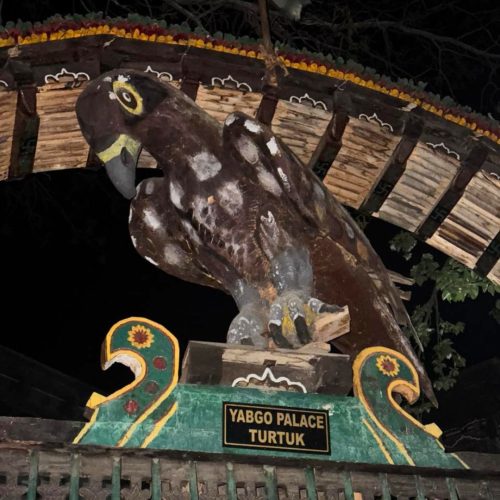
After dinner, we explored the upper floor, where family heirlooms are displayed alongside painted genealogies, antique swords, and hunting trophies. A small balcony offered sweeping views of a night sky so densely scattered with stars that it seemed almost unreal… It was difficult to tear myself away, yet we bid adeieu, for the next morning we would travel deeper into the heart of the Nubra Valley.
THE APRICOT BLOSSOM FESTIVAL
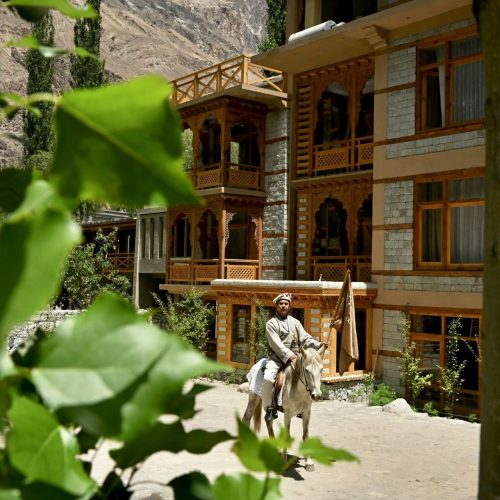
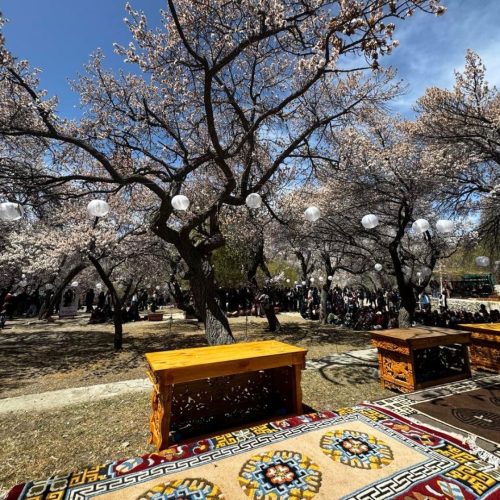
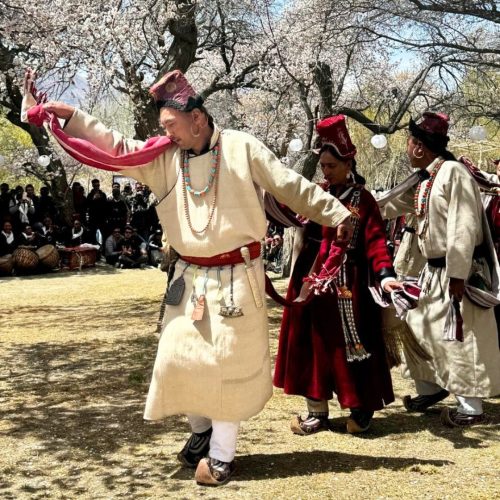
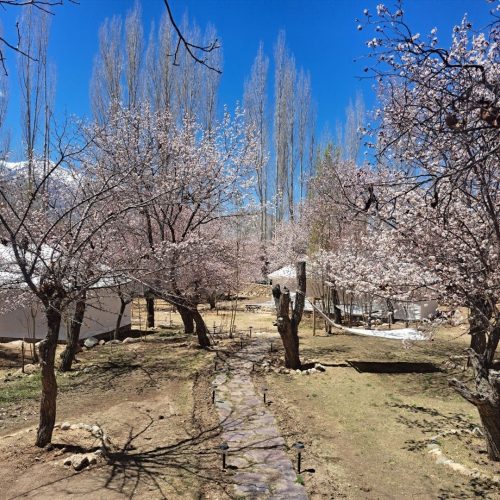
The rhythmic drumming of the Daman drum rose through the row of performers under pink apricot blossom trees. Earlier that day, we had departed at dawn to attend the Apricot Blossom Festival in the Nubra valley, which takes place on only one day between March and mid-April to celebrate the arrival of Spring. After checking into our stone cottages at the Lchang Nang Retreat in the Tegar Village, we made our way to the nearby clearing where residents from neighbouring villages had travelled to celebrate the local Chulli Mendok festival.
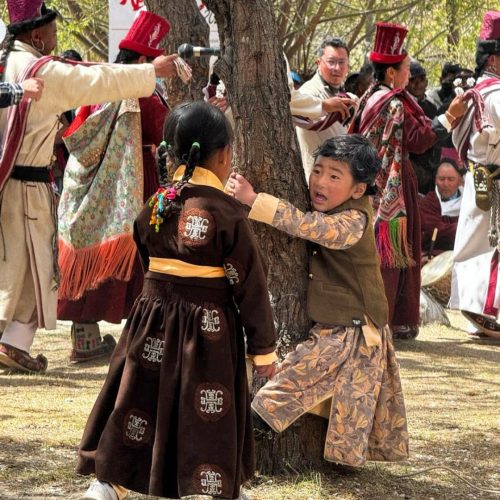
Women arrived dressed in vibrant sulma robes, while some elderly attendees wore beautifully embroidered kantop caps distinguished by their pointed sides.
The Apricot Blossom Festival is one of the most charming celebrations one can experience. In an era when many cultural events are increasingly curated for social media, this gathering remains refreshingly authentic. Located on the ancient Silk Route, the festival was introduced by the Ladakh Tourism Department in 2021, and it continues to retain an intimate atmosphere, celebrating local traditions and community spirit.
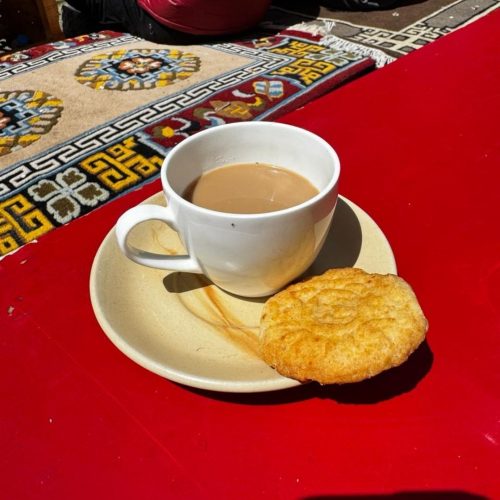
In the centre of the gathering, performers presented traditional dances—those performed at weddings, during Spring, and even folk theatre. Throughout the festival, guests were offered cups of butter tea alongside local delicacies, and during the final performance, spectators were invited to join the dancers, forming circles and moving together to traditional melodies.
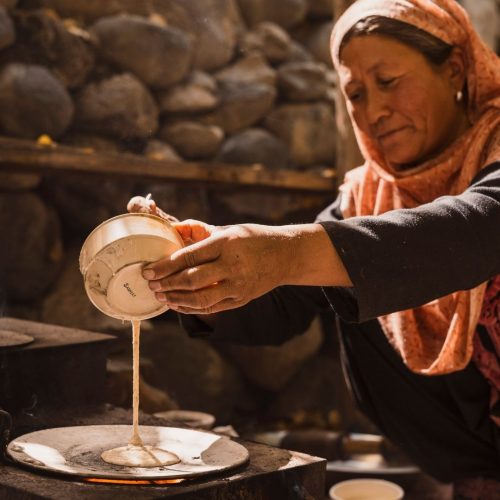
A cheerful chatter continued after the show, and nearby, artists painted Bodhisattvas, craftsmen carved fantastical dragons from wood, and food stalls served freshly prepared local dishes. Nearby, monks practised archery while villagers performed the sacred ploughing ritual, known as Saka, using yaks. We sampled local chhaang and shared pieces of freshly baked paba bread made from barley, completing an afternoon rich in culture, tradition, and hospitality.
For fashion enthusiasts, there’s much to appreciate, especially the Perak, the elaborate ceremonial headdress worn by Ladakhi women. As Rigzin Wangtak Kalon, founder of Lchang Nang Retreat explained to us over dinner, the Perak is adorned with turquoise stones passed down through generations of women within the same family. Some headdresses contain stones accumulated over centuries, making them treasured heirlooms that embody family history and identity.
Interestingly, the turquoise itself is not native to Ladakh. Instead, it arrived through ancient Silk Route trade networks linking Persia, Tibet, and Central Asia. Historically, the Perak has served as a symbol of lineage, wealth, and social status, and when paired with the traditional goncha robe and layered coral and gold jewellery, it becomes a powerful expression of womanhood.
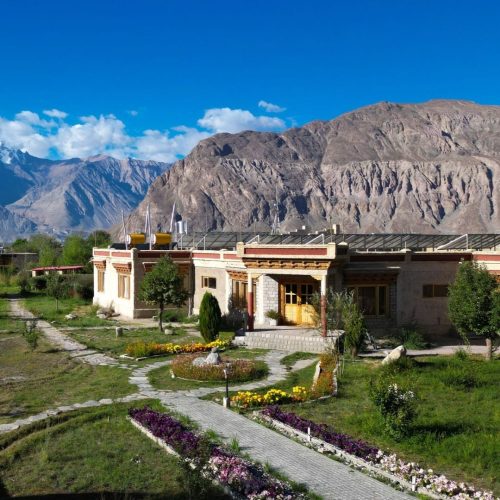
Once the festivities drew to a close, we returned to Lchang Nang Retreat, a property that serves as a heartfelt tribute to Ladakhi culture and heritage. Founded by Rigzin Wangtak Kalon, the retreat reflects his vision of creating meaningful, sustainable luxury in one of India’s most extraordinary landscapes.
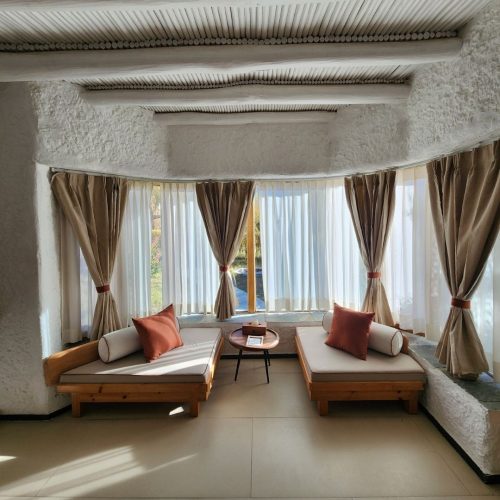
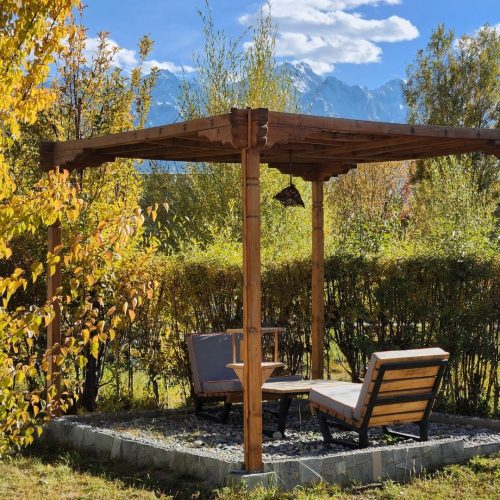
After years in Delhi’s fast-paced corporate world, Rigzin returned to Ladakh with a mission: to preserve the traditions of the region while creating opportunities for local communities. With sweeping views of the Karakoram, Ladakh, and Himalayan ranges, the retreat occupies an enviable location in the Nubra Valley. The property comprises 17 cottages, each featuring a private garden and sit-out area overlooking the mountains.
The resort is a celebration of conscious luxury, with the aim to reduce Ladakh’s carbon footprint: the cottages have been made using traditional methods with local materials such as river rocks, mud, and poplar wood, and there is no concrete in the buildings. As for their delicious meals, many ingredients are sourced from the family’s own orchards, fresh and flavourful.
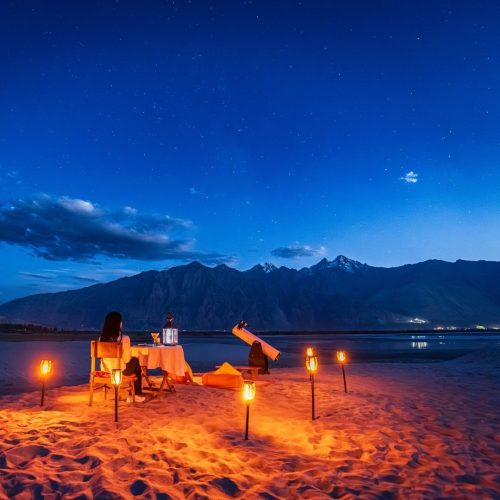
While staying here, take a moment to pause…after all, you are in the heart of the Nubra Valley that is the orchard of Ladakh. To immerrse yourself deeper into the landscape, the retreat can arrange a sundowner experience amid the neighbouring Sumur Sand Dunes. As the sun sinks behind the mountains, the landscape transforms into a palette of gold, amber, and rose, while Bactrian camels wander across the dunes—a reminder of the ancient trading routes that once connected Central Asia to the Indian subcontinent. Couples looking for a romantic escape can indulge in a private five-course degustation dinner beneath the elm trees. There’s even a chef’s tasting featuring landmark culinary treasures from sojourns along the ancient Silk Route, which is a must try.
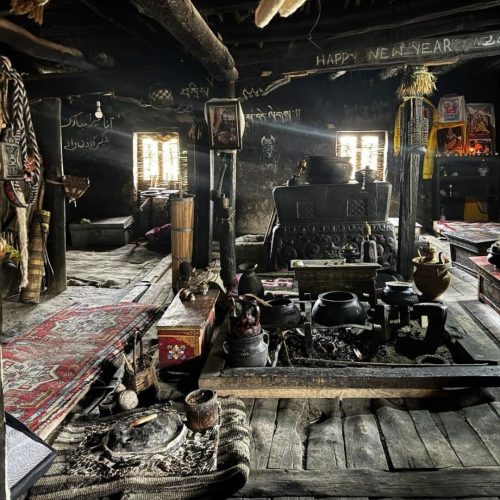
One morning, we visited a 400-year-old ancestral house nearby, to step into history. After breakfast, we walked through the scenic village until we came upon the beautifully preserved stone and wood residence. The main living quarters occupied the upper floor, where sunlight streamed through ebony-framed windows and illuminated the centuries-old interiors. Inside, we were welcomed by the women of the household, who served us rice puffs and homemade chhaang. Time slowed down, as we learnt about how life was lived hundred of years ago, when caravans traversed the mountains on their way to distant kingdoms.
TRAVEL THROUGH TIME
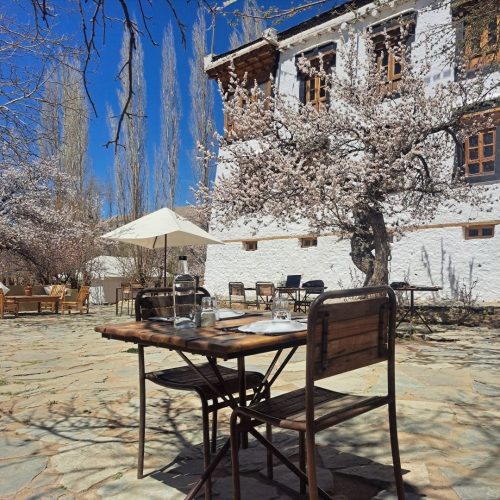
Our final destination was Nimmu House, located in Nimmoo village, where we arrived in the early evening. As we gathered beneath a flowering tree in the courtyard, a Eurasian magpie perched on a nearby wall, eyeing the fruit trees with apparent interest. Around us, apricot, apple, and walnut trees stretched across the property, while mountain peaks rose dramatically in the distance.
The scene felt impossibly serene…a fitting finale to a journey defined by extraordinary landscapes and meaningful encounters.
Nimmu lies approximately 45 minutes from Leh and is often referred to as the “Gateway to Zanskar”. The village is particularly renowned for its proximity to the confluence of the jade-green Indus River and the deep-blue Zanskar River, one of Ladakh’s most iconic natural landmarks. Among the region’s most celebrated heritage properties, Nimmu House has become a sought-after retreat for travellers seeking an authentic and immersive Ladakhi experience. It is little wonder that reservations are often fully booked during the travel season from April to October.
Nimmu House was built a century ago for the cousin of the King of Ladakh, modelled after a nobleman’s home in Lhasa. Constructed entirely from local, sustainable materials like sun-dried mud bricks, timber, and stone, it is a self-contained ecosystem. Upon entering, you’ll notice the stables on either side where the cows, yaks, and dzos would rest to protect them from the cold as well as provide natural insulation for the rooms above.
The upper floor contains two private Buddhist temples, where painstaking restoration work has preserved historic paintings, maps, and decorative details. Throughout the property, the original architecture has been carefully maintained, allowing guests to experience the house much as it would have appeared generations ago.
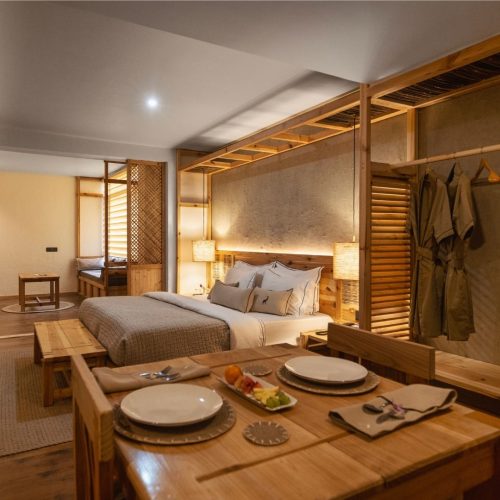
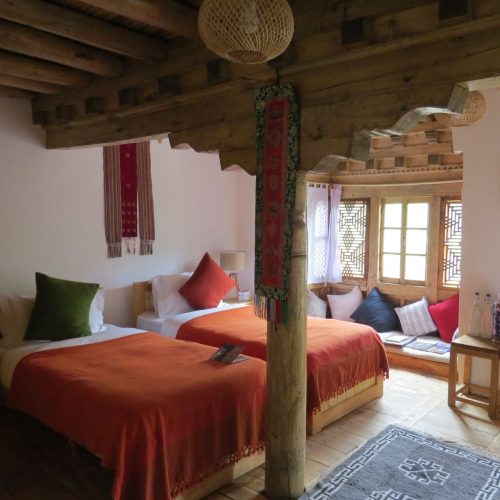
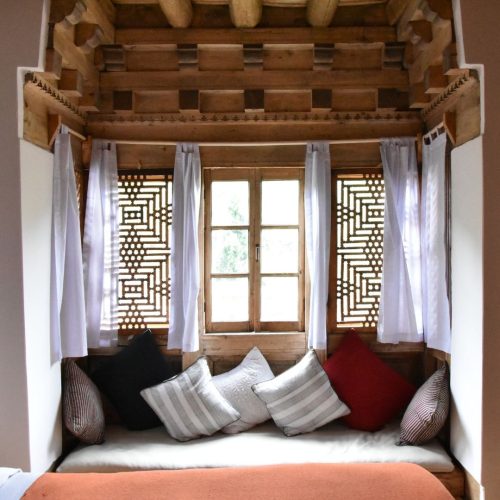
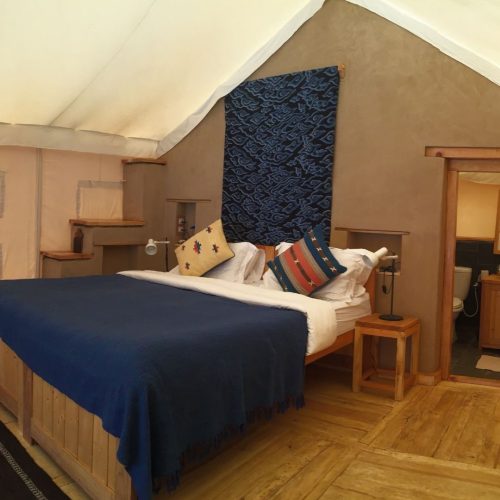
There are only five traditional heritage rooms at Nimmu House, and my spacious suite consisted of two rooms, a beautiful view from the windows, and very low doors that were designed to conserve warmth during winter. For travellers wishing to stay closer to nature, the property also offers seven luxurious glamping tents nestled within the orchard, combining comfort with immersion in the landscape.
Days at Nimmu House unfold at an unhurried pace. Here, guests can get an invigorating massage, participate in guided meditations with the lovely Indrani, partake in a memo-making class, or simply wander through the gardens and surrounding village. By evening, gather in the courtyard to enjoy some chhaang around a bonfire, and listen to stories of the Indo-China war, and how the building survived a cannon attack that missed the building and landed in that very courtyard.
The stories flowed freely, and later that night, I retreated to my room and slipped beneath layers of warm blankets on a heated bed. As I lay my head on my pillow, memories from the past week replayed in vivid detail: monasteries perched on mountaintops, apricot blossoms swaying in the breeze, ancient palaces illuminated by candlelight, and endless roads winding through some of the most spectacular scenery on Earth.
A FRESH LEASE
A week in Ladakh is never enough.
Every valley reveals another story, every mountain pass opens onto another breathtaking vista. Far away from the hubbub of the city life, where some parts don’t receive any connectivity, Ladakh offers something increasingly rare in modern travel: the opportunity to be fully present. Without constant notifications and endless scrolling, the landscape commands attention, conversations become richer, and time feels expansive once again.
No description, however detailed, can fully capture what it feels like to stand beneath apricot blossoms in the Nubra Valley, watch prayer flags flutter against snow-covered peaks, or listen to ancient stories shared beside a fire under a sky ablaze with stars.
You just have to be there.
Bookings can be made through Rare India by Shoba Rudra.
READ MORE
- Ladakh’s Pink Blossoms Are An Exquisite, Luxurious Celebration
- What Happens When One Of The World’s Most Sought-After Whisky Brands Enters A Design Event?
- “I’ve Been In Love With the Ponduru Khadi Weave Since My Wedding”
- The Much-Awaited Alexander Shorokhoff Watches Enter India With Titan’s Helios Luxe
- Artist Paresh Maity Is Chasing The Light In His New Solo Exhibition